
Table of Contents
- What Growth Mindset Actually Means (and What It Doesn’t)
- Growth Mindset Scripts for Parents: What to Say When It Matters
- Praise Effort and Strategy, Not Just Outcomes
- Teaching Kids to Handle Frustration and Setbacks
- Growth Mindset Activities for Kids That Build Real Persistence
- Journaling for Kids Growth Mindset: Reflection That Sticks
- Model Growth Mindset in Your Own Life
- Small Routines That Reinforce Growth Mindset Every Day
- Frequently Asked Questions
**
What Growth Mindset Actually Means (and What It Doesn’t)
To foster growth mindset is to help children believe that abilities and intelligence can be developed through effort, practice, and learning. It’s not about being positive all the time or pretending challenges don’t hurt. It’s about understanding that struggle is part of learning, not a sign of failure.
The opposite is a fixed mindset, the belief that your talents are locked in place. If a child thinks they’re “bad at math” or “not creative,” they stop trying. A growth mindset says, “I’m not good at this yet, but I can improve.”
Here’s what matters: fostering a growth mindset doesn’t mean your child will never feel frustrated, scared, or discouraged. It means they won’t stay stuck in those feelings. They’ll see setbacks as feedback, not proof they’re not capable.
Many parents worry they’re doing this wrong. The truth is simpler than you think. You don’t need special programs or constant cheerleading. You need to shift a few small things about how you respond when your child struggles.
Growth mindset isn’t about toxic positivity. Kids need to feel their feelings fully. The difference is what they tell themselves after the frustration passes. That’s where real change happens.
Growth Mindset Scripts for Parents: What to Say When It Matters
The words you use matter more than you might think. When your child hits a wall, your response teaches them whether struggle means they’re failing or learning.
When your child says “I can’t do this”
This is the moment that shapes everything. Your child is at a crossroads. They can either shut down or lean in.
Instead of “Yes, you can!” try: “You can’t do it yet. Let’s figure out what you need to understand it.”
This single word, yet, changes everything. It tells your child the problem isn’t permanent. It’s not about their ability. It’s about time and effort.
Other scripts that work:
- “What part is tricky? Let’s break it down.”
- “What would help you right now? Do you need a break, a different approach, or my help?”
- “I notice this is hard. That means you’re working through something new.”
The key is staying curious instead of rushing to fix it. Let your child sit with the challenge for a moment. That discomfort is where learning lives.
When your child makes a mistake
Mistakes are the best teachers, but only if your child sees them that way. If you react with frustration or disappointment, they learn to hide mistakes instead of learning from them.
Try: “What can you learn from this? What would you do differently next time?”
This shifts the focus from shame to strategy. Your child moves from “I messed up” to “Here’s what I can do better.”
Other helpful responses:
- “Mistakes help us learn. What does this one teach you?”
- “Let’s look at what went wrong so we understand it.”
- “I’m glad you tried. Now let’s see what we can adjust.”
Avoid: “It’s okay, don’t worry about it.” This dismisses the mistake instead of mining it for learning. Also avoid: “Why didn’t you just…?” This sounds like blame.
When your child compares themselves to a sibling or peer
Comparison is the thief of joy, and kids do it constantly. “She’s better at soccer than me.” “He finished first.”
Instead of dismissing the comparison, acknowledge it: “I hear you. Everyone’s on their own path. What matters is whether you’re getting better at what you care about.”
Then ask: “What’s one thing you could practice to improve?”
This keeps the focus on their own growth, not the scoreboard. It also teaches them that other people’s success doesn’t diminish theirs.
Other scripts:
- “You’re noticing a difference. That’s good awareness. Now, what do you want to work on?”
- “Comparing ourselves to others can feel bad. Let’s focus on your own progress instead.”
- “Everyone starts somewhere different. What matters is the effort you put in.”
The most powerful script is the one that moves your child from “I’m not good at this” to “I’m not good at this yet, but here’s what I can do.” That shift in thinking changes everything.
Praise Effort and Strategy, Not Just Outcomes
This is where many well-meaning parents go wrong. Praising intelligence (“You’re so smart!”) actually backfires. Kids who hear this start avoiding challenges because they’re afraid of losing the “smart” label.
Praise effort instead: **”You worked really hard on that.
When you praise strategy, you teach your child how to improve:
- “You broke the problem into smaller steps. That helped you understand it.”
- “You asked for help when you needed it. That’s smart problem-solving.”
- “You tried a different approach when the first one didn’t work.”
What to avoid:
- Praising outcomes alone (“You got an A!”)
- Praising ability (“You’re so talented”)
- Over-praising easy wins (save the enthusiasm for genuine effort)
- Praising compliance instead of thinking (“You listened so well”)
Teaching Kids to Handle Frustration and Setbacks
Frustration is where growth mindset either sticks or falls apart. If your child learns to handle frustration, they can develop valuable coping skills. If they consistently avoid it, they may miss opportunities to grow through challenges.
Name the feeling without fixing it immediately
When your child is frustrated, the first instinct is to make it stop. Don’t. Let them feel it.
Help them identify what went wrong (not who went wrong)
When a child makes a mistake, they often blame themselves: “I’m stupid.” Your job is to separate the person from the problem.
Ask questions:
- “What happened?”
- “What were you trying to do?”
- “What could you try differently?”
- “What would help?”
Avoid saying “It’s not a big deal” or “You’ll get it next time.” This dismisses their effort. Instead, acknowledge the difficulty and help them see the path forward. Frustration that gets validated and worked through can help build resilience. Frustration that gets dismissed may teach kids to hide their struggles.
Growth Mindset Activities for Kids That Build Real Persistence
A practical way to foster a growth mindset is through doing things that are just hard enough to require effort but not so hard they feel impossible.
For younger children (ages 4-7)
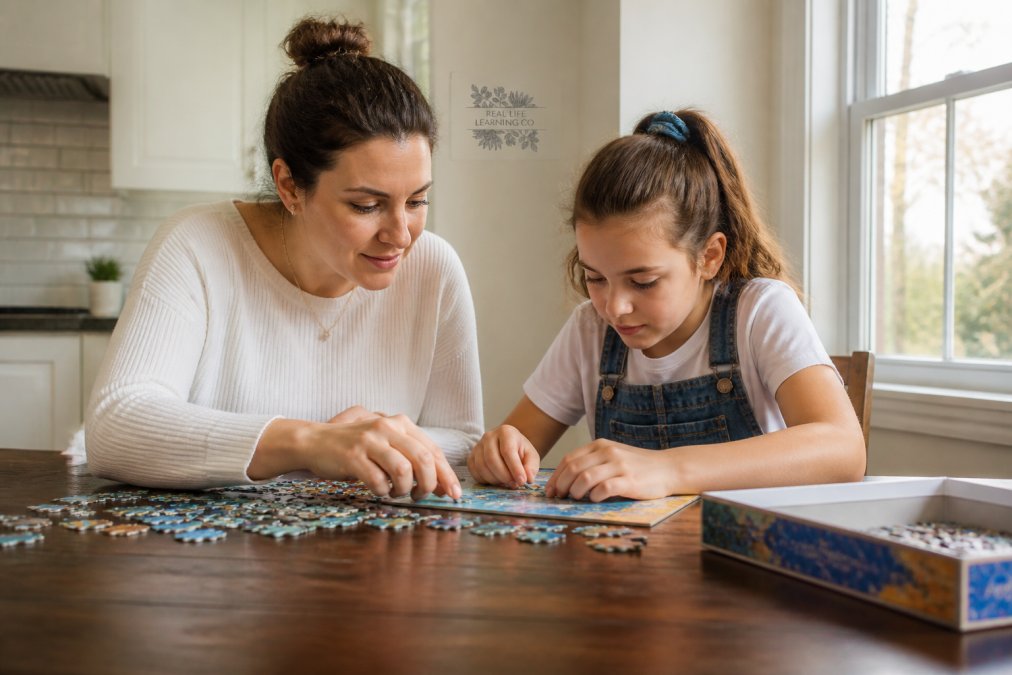
Puzzle challenges: Start with puzzles at their level, then gradually increase difficulty. The goal isn’t to finish fast. It’s to notice: “I couldn’t do this last week, and now I can.”
For older children (ages 8-12)
Goal-setting with check-ins: Help them pick something they want to get better at. Not something easy. Something that requires practice. Check in weekly: “What did you work on? What got easier?”
Journaling for Kids Growth Mindset: Reflection That Sticks
Reflection can help learning become more lasting. When kids write about what they learned, what was hard, and what they’ll try next, it can help those lessons stick.
Simple journaling prompts that work:
- “What was hard today? What did I learn?”
- “What did I try that didn’t work? What will I try next?”
- “When was I frustrated? What did I do?”
- “What’s something I’m better at than I used to be?”
- “What challenge am I working on right now?”
Model Growth Mindset in Your Own Life
Your child watches how you handle frustration, mistakes, and challenges. If you avoid hard things, they may be more likely to do so. If you lean into them, they may be more likely to do so as well.
Talk out loud about your own learning:
- “I messed up that recipe. Let me try a different way.”
- “This is hard. I’m going to stick with it and see if I can figure it out.”
- “I didn’t know how to do that, so I watched a video and tried. Now I can.”
Small Routines That Reinforce Growth Mindset Every Day
You don’t need big moments. Small, consistent routines build the strongest mindset.
Frequently Asked Questions
How can I praise effort without overpraising or making it feel fake?
Be specific about what you noticed. Instead of ‘Great job,’ try ‘I saw you try three different ways to solve that problem’ or ‘You kept going even when it was hard.’ Mention the actual effort or strategy, not just the outcome. This feels genuine because it’s true, and it teaches your child to recognize what they actually did. Avoid adding ‘You’re so smart’, that shifts focus back to ability rather than effort.
What should I do when my child gets frustrated and wants to quit?
First, acknowledge the frustration: ‘I see this is really hard right now.’ Don’t rush to fix it or tell them to keep trying. Let them sit with the feeling for a moment. Then, ask what they want to do next, take a break, try a different approach, or ask for help. This teaches them that frustration is information, not a stop sign. Sometimes the best response is ‘Let’s come back to this later,’ which models that persistence doesn’t mean pushing through every moment.
How does journaling help kids develop a growth mindset?
Journaling gives kids a private space to reflect on their learning, mistakes, and efforts without judgment. When children write about what they tried, what didn’t work, and what they’ll do differently next time, they’re practicing metacognition, thinking about their own thinking. This turns mistakes into data rather than failures. A simple journal prompt like ‘What was hard today and what did I learn?’ helps kids see setbacks as part of the learning process.
Can I foster growth mindset if my family is traditional or not naturally ‘positive’?
Absolutely. Growth mindset isn’t about being cheerful or always optimistic. It’s about recognizing that effort, strategies, and persistence can help you improve. You don’t need to be a ‘conscious parent’ or overhaul your whole approach. Start small: notice when your child tries hard, talk about mistakes as learning opportunities, and model how you handle your own challenges. Real families are messy and frustrated sometimes, that’s actually the best place to practice resilience.
Raising kids who embrace challenges and learn from setbacks takes practice, for you and for them. The scripts, activities, and routines in this guide give you concrete ways to start today. Real Life Learning Co is here to support this journey with warm, practical resources designed for real family life. Whether through journaling, reflection, or daily connection, small, consistent actions build the confident, resilient kids you’re raising.