
Table of Contents
- Why Non-Screen Activities Matter for Family Connection
- Indoor Creative Arts and Hands-On Learning
- How to Teach Kids About Gratitude Through Daily Rituals
- Active Play, Outdoor Exploration, and Physical Movement
- Family Connection Rituals That Build Belonging
- Conscious Parenting Activities for Emotional Growth
- Making Screen-Free Time Stick: Low-Prep Ideas for Busy Families
- Frequently Asked Questions
Why Non-Screen Activities Matter for Family Connection
Non-screen activities family bonding creates something screens can’t replicate. They build real connection, give kids space to think and create, and let families talk without interruptions.
This guide covers practical, screen-free ways to strengthen your family bond through activities for different ages, low-prep ideas for busy days, and rituals that stick.
Indoor Creative Arts and Hands-On Learning
Creative projects give kids a way to express themselves while you’re in the same room together. They work with their hands, spark conversation, and require no “right answer”, just imagination and time together.
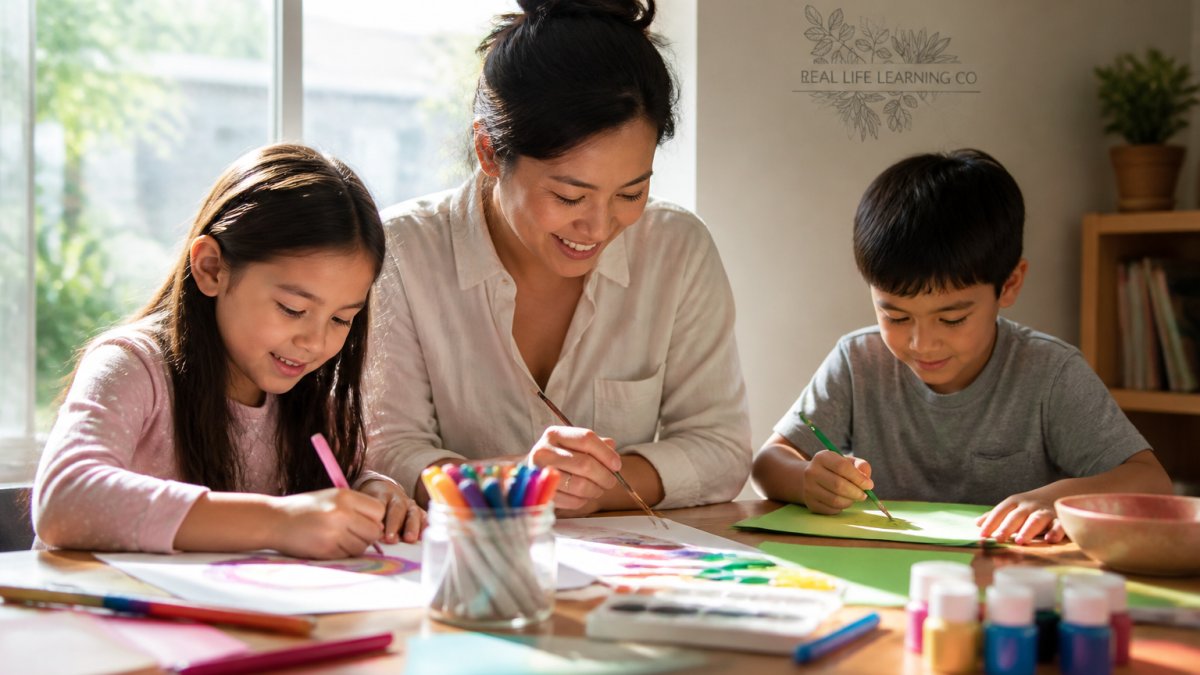
Activities that work:
- Art projects (painting, drawing, collage, clay)
- Building with blocks, LEGO, or cardboard
- Cooking or baking together
- Crafting with household items (no special supplies needed)
- Sewing, weaving, or fiber projects for older kids
- Making a fort or redesigning a room
Sit nearby, ask questions, and let kids lead. “What are you making?” opens more conversation than directions.
How to Teach Kids About Gratitude Through Daily Rituals
Kids learn gratitude by practicing it and seeing you practice it. Daily rituals work because they’re short (3-5 minutes), happen at the same time, give kids language for naming good things, and create calm moments together.
Age-specific approaches:
Simple rituals to try:
- At dinner, each person shares one good thing that happened (or one thing they’re grateful for)
- Before bed, ask “What made you smile today?” or “Who did you feel close to?”
- During a car ride, play “I spy something I’m grateful for” (combines movement with gratitude)
- In the morning, say one thing you’re looking forward to (future-focused gratitude)
- Keep a gratitude jar and read notes together on Sundays
- During a walk, point out things you notice and appreciate (trees, weather, sounds)
Common barriers and how to handle them:
Active Play, Outdoor Exploration, and Physical Movement
Kids need to move to think clearly, regulate emotions, and be present with you. Shared movement creates shared experience, calms everyone, and helps kids sleep better.
Screen-free active ideas:
- Walk or bike ride (no destination needed)
- Play tag, catch, or other running games
- Jump rope, hula hoops, or chalk games on the driveway
- Climb trees, explore a park, or hunt for nature items
- Kick a ball around, play badminton, or shoot hoops
- Dance in the living room to music
- Scavenger hunts (inside or outside)
Family Connection Rituals That Build Belonging
Rituals are the glue of family life. They happen regularly, everyone knows what to expect, and they’re about connection, not performance.
Rituals that build belonging:
- Family dinner nights (same night each week, no screens)
- Sunday morning pancakes or a special breakfast
- Movie night with popcorn and blankets
- Game nights with the same games or rotating choices
- Bedtime routines with talking time
- Weekly walks or bike rides
- Cooking a recipe together every Saturday
- Reading aloud before bed
- Celebrating small wins (good test, finished a book, tried something new)
Conscious Parenting Activities for Emotional Growth
Conscious parenting means helping kids learn to handle big emotions. Non-screen activities family bonding creates the conditions where this happens, though different activities work for different kids.
How non-screen activities support emotional growth:
-
Unstructured time gives kids space to feel and process. When there’s no external stimulation (screens, constant input), kids’ nervous systems can settle. Boredom sometimes leads to creativity or deeper conversation, but more importantly, it gives kids room to notice and name what they’re feeling.
-
Shared activities create safety for talking about hard things. Direct eye contact can feel intense for some kids. Side-by-side activities (walking, cooking, building) reduce that intensity and make it easier for kids to open up. They’re doing something together, so the conversation feels less like an interrogation.
-
Doing things together (not just talking about them) helps kids learn. Kids don’t learn emotional skills from lectures. They learn by watching you handle frustration when a recipe fails, seeing you apologize when you’re wrong, and experiencing what it feels like to work through a problem together.
-
Repetition and routine build emotional resilience. When kids do the same activity regularly, they know what to expect. That predictability helps their nervous systems relax, which makes them more available for connection and learning.
Activities organized by how they support emotional growth:
For kids who need to move or fidget while processing:
- Walking or hiking (movement helps regulate the nervous system; side-by-side reduces eye-contact pressure)
- Cooking or baking (hands are busy, which helps some kids think and talk more freely)
- Building projects that require teamwork (LEGO, blocks, cardboard forts)
- Yard work or gardening together (physical work + nature + purpose)
- Dancing or moving to music
For kids who process through creating:
- Art projects where feelings can come out without words (painting, clay, collage)
- Writing or journaling (some kids find this easier than talking)
- Building or designing (kids often express what they’re feeling through what they create)
- Music-making (singing, playing instruments, even just listening together)
For kids who need quiet or lower-stimulation environments:
- Reading books together and talking about characters’ feelings (lets kids explore emotions at a distance first)
- Puzzles or quiet building (calming, rhythmic, low-pressure)
- Sitting outside together without a specific activity (sometimes just being present is enough)
- Drawing or coloring side-by-side
- Listening to audiobooks or podcasts as a family
For kids who learn through games and turn-taking:
- Playing games that involve taking turns, losing, and trying again (teaches emotional regulation in a structured way)
- Card games or board games with simple rules (repeated practice with winning and losing)
- Conversation games like “Would You Rather” or “20 Questions” (low stakes, builds comfort with talking)
For kids who are neurodivergent or have sensory sensitivities:
- Offer choices within activities (“Do you want to paint or draw?” gives control)
- Allow fidget tools during conversations (stress balls, textured objects)
- Respect need for breaks or quiet time without judgment
- Use timers so transitions are predictable
- Pair talking with a repetitive activity (coloring, building, walking)
- Avoid overstimulation (too many people, too much noise, too many choices at once)
What emotional growth actually looks like:
The goal isn’t to fix feelings or make kids happy all the time. It’s to help them:
- Notice what they’re feeling (“I’m frustrated” instead of just acting frustrated)
- Know they’re not alone in those feelings
- See that you can feel something hard and still be okay
- Learn that feelings pass and change
- Practice handling disappointment, frustration, or sadness in a safe space
Creating the conditions for emotional growth:
- Show up without an agenda. You don’t need to “teach” anything. Your presence and attention are the lesson.
- Name what you notice without judgment. “I see you’re frustrated” is different from “Stop being frustrated.” The first validates; the second dismisses.
- Share your own feelings. “I felt nervous about that too” or “I didn’t know how to handle that at first either” shows kids that all feelings are normal.
- Let activities be messy. A failed recipe or a “bad” drawing is often where the real learning happens, kids see that mistakes don’t mean failure.
- Respect your child’s pace. Some kids warm up to conversation quickly; others need weeks of side-by-side time before they open up. Both are okay.
Making Screen-Free Time Stick: Low-Prep Ideas for Busy Families
You don’t need hours of planning to create screen-free time. You need ideas that actually fit your life.
Why low-prep matters:
- Busy families won’t do elaborate activities consistently
- Simple ideas work just as well as complicated ones
- Less planning means more time actually connecting
- Kids often prefer simple activities anyway
No-prep activities:
- Conversation games (20 questions, would you rather, story building)
- Cooking with what you have (not a special recipe)
- Playing with toys or building materials already in the house
- Going outside (no equipment needed)
- Reading books you already own
- Doing puzzles together
- Listening to audiobooks or podcasts as a family
- Drawing or writing with paper and pencils
- Playing card games or dice games
- Helping with real household tasks
Activities that take 10 minutes to set up:
- Scavenger hunts (write a quick list)
- Baking (use a simple recipe)
- Craft projects (gather supplies you have)
- Picnics (pack snacks and go to the backyard)
- Movie night (choose the movie, make popcorn)
Frequently Asked Questions
What are some low-prep non-screen activities I can do right now with my kids?
Start with what you already have: build a blanket fort, play a card game, cook together, go for a neighborhood walk, or have a storytelling session. These require no setup but create real connection. For slightly more prep, try a scavenger hunt around your house, a family art project, or collaborative cooking. The key is consistency over complexity, activities your family returns to matter more than elaborate one-time events.
How do non-screen activities help build emotional intelligence in children?
Screen-free time creates space for real conversation, problem-solving, and face-to-face interaction. When kids play together, navigate disagreements, create something, or work toward a shared goal without screens, they practice listening, expressing feelings, managing frustration, and reading others’ emotions. These are the actual skills that develop emotional intelligence, and they happen naturally during unstructured and collaborative play.
How can I teach my kids about gratitude in ways that feel genuine, not forced?
Gratitude sticks when it’s woven into daily life, not performed. Notice small moments, a meal someone prepared, a sunny day, a friend’s kindness, and name them casually during conversation. Create a simple ritual like sharing one good thing at dinner, or keep a gratitude jar where family members add observations throughout the week. Kids learn gratitude by watching you practice it and by experiencing how good it feels to acknowledge what matters.
What’s the difference between unstructured play and intentional family activities?
Unstructured play happens when kids have time and space to create their own activities, building, imagining, exploring. Intentional family activities are planned moments where you’re together with a shared purpose: cooking a meal, playing a game, or tackling a project. Both matter. Unstructured play builds creativity and independence; intentional activities strengthen connection and teach collaboration. Families thrive with a mix of both.
The real work of conscious family bonding isn’t finding the perfect activity. It’s showing up consistently and being present when you do. Screen-free time works because it gives your family space to be together without interruption. Start with one or two ideas that fit your life. Build from there. The moments you create now become the memories your kids carry forward.